For riders who want immersive, app-enabled indoor rides, virtual cycling trainers offer a bridge between real-world terrain and simulated courses. This guide highlights five top options that pair with popular apps like Zwift, TrainerRoad, and others. Each product balances realism, power accuracy, noise level, and setup convenience to help you choose the right system for your space and goals.
| Product | Brand | Key Feature |
|---|---|---|
| Saris M2 Smart Indoor Bike Trainer | Saris | Wheel-on, +/-5% accuracy, 69 dB at 20 mph |
| Saris Fluid2 Indoor Bike Trainer | Saris | Realistic road-like feel, quiet operation |
| Garmin TacX Boost Trainer Bundle | Garmin | Magnetic brake, speed sensor included |
| Elite Rivo Zwift Ready Smart Trainer | ELITE | Direct drive, ±2.5% power, 18% climbs |
| ThinkRider X2Max Smart Bike Trainer | ThinkRider | 18% slope simulation, BLE & ANT+ |
Saris M2 Smart Indoor Bike Trainer

The Saris M2 is a wheel-on trainer designed for easy setup and immediate integration with Zwift. It connects to the rear wheel, removing the need to remove the wheel or disassemble the bike. It delivers a controlled and consistent workout with electromagnetic resistance, and it operates at a measured noise level of 69 decibels at 20 mph, supporting precise training with +/- 5% power accuracy. This model is well-suited for riders who want a realistic ride feel without direct-drive complexity.
Saris Fluid2 Indoor Bike Trainer
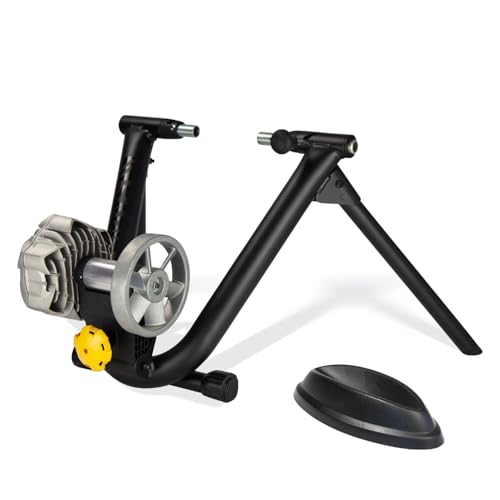
The Fluid2 offers a realistic road-like ride with progressive resistance that increases as you pedal harder, mirroring outdoor performance. Its large precision-balanced flywheel keeps noise low while maintaining a smooth, whisper-quiet experience. Easy setup and a classic foldable frame make this trainer ideal for space-conscious users who want a dependable, realistic feel for Zwift sessions and structured workouts.
Garmin TacX Boost Trainer Bundle

The TacX Boost Bundle includes a powerful magnetic brake and a speed sensor to track speed along with distance, enabling training with popular apps like TacX Training, TrainerRoad, and Zwift. The bundle supports multiple rear-axle widths and provides adjustable resistance with up to 1050 watts, making it a versatile option for riders who want app-based workouts and data integration in a compact, cost-effective package.
Elite Rivo Zwift Ready Smart Trainer

The Elite Rivo is a direct-drive trainer designed for Zwift readiness, featuring pre-installed Zwift Cog and Click for instant virtual cycling. It offers 24 silent virtual gears, compatibility with a wide range of drivetrains, and automatic resistance control. With up to 2,100 watts of power and 10 Hz data transmission, it delivers quick, accurate responses for Zwift races and workouts while maintaining ultra-quiet operation—ideal for apartment living and home gyms.
ThinkRider X2Max Smart Bike Trainer

The ThinkRider X2Max combines strong compatibility with BLE and ANT+ dual mode for use with Zwift and other software. It features a DEPT dynamic electromagnetic torque power meter delivering up to 2000W with modest ±2% power accuracy. An intelligent variable resistance system simulates up to an 18% incline and automatically aligns resistance with the map tilt when connected to riding software for a realistic indoor cycling experience.
Buying Guide: Key Purchase Considerations
Choosing a virtual cycling trainer depends on how you ride, space, and budget. Consider wheel-on versus direct-drive options: wheel-on trainers are easier to set up and cheaper, but direct-drive units generally offer higher power accuracy, quieter operation, and less tire wear. Power accuracy and peak output influence how accurately your indoor workouts translate to training plans and virtual routes.
- Connectivity and ecosystem: Ensure the trainer works with your preferred apps (Zwift, TrainerRoad, MyWhoosh, Rouvy, etc.). Look for dual BLE/ANT+ support for broad compatibility.
- Noise and ventilation: Quiet models are essential for apartment living or shared spaces. Note decibel ratings if available and the type of resistance (magnetic, fluid, or direct drive).
- Resistance realism and incline: Realistic road-like feel and gradient simulation improve training specificity, especially for structured workouts and racing sims.
- Power accuracy and consistency: Higher accuracy (often within +/-1% to +/-2.5%) translates to better training data and pacing during workouts and races.
- Ease of setup and storage: Foldable frames and wheel-on designs simplify initial setup and storage, while direct-drive units may require more installation effort but offer cleaner integration.
- Bike compatibility: Check axle standards and drivetrain compatibility to avoid adapters or adjustments. Many trainers specify supported widths and tire mounting requirements.
- Future-proofing: Firmware updates, app support, and ecosystem partnerships influence long-term usability; consider models with active development communities and regular updates.
When selecting, balance realism, data fidelity, and convenience with your training goals. For competitive or long-term use, a direct-drive trainer with Zwift-ready features and a robust power meter may provide the best return on investment, while wheel-on options suit casual training and entry-level setups.